A beginners guide to casting a Multiplier reel.If you're starting out angling and you're reasonably serious about progressing, you need to learn how to cast a multiplier reel.
To start off with, you need:
- A 12-14 ft Rod, rated 2-4oz or 4-6oz with a Medium action.
- A Multiplier reel
- Appropriate diameter nylon
- Leader
- Sinkers according to the rod rating
A rod with a Trigger winch helps with handling the rod and reel.
 Balancing your equipment
This is crucial to successful casting.
All your equipment needs to be 'balanced' together - working together as a unit.
eg: A big reel on a small rod will not be easy to use. Similarly, large diameter line on a small reel will not work well.
As a point of reference and just as an example, use the following as a guideline:
Daiwa reels size 30 - use 0.35-0.4 mm mono as your mainline.
Shimano reels size 30/Daiwa reels size 50 - use 0.45-0.55mm mono.
(Bear in mind that thinner diameter line is easier to cast and also casts further.)
Shimano reels size 30/Daiwa reels size 50 - should be used on a 13-14ft rod, rated at 6-8oz (sinker weight)
Daiwa reels size 30 - can be used on 12-14ft rods, rated at 4-6 oz
Generally, the greater the diameter of your mainline, the bigger the size sinker you need to keep the reel turning during it's flight.
The greater the diameter of the mono, the greater the wind resistance through the air---> the greater the drag ---> the quicker the sinker will slow down.
This is the reason why one can cast much further using thinner diameter line.
To keep things balanced:
Eg. Using a Daiwa Saltist 50/Shimano Torium 30 with 0.55mm line on a rod rated 6-8oz - you will need an 8oz sinker to keep the reel turning and overcome wind drag during the cast.
Eg: Using a Daiwa Saltist 30 with 0.35mm line on a 4-6oz rod - you can use a 4 or 5oz sinker.
These are just guidelines. There are many other factors to consider, (including casting style and quality of equipment), to take into account. As you gain more experience, you will find what works for you.
Dynamics of CastingYou, your rod, reel, line, leader and sinker need to be matched together in order to produce consistent trouble-free casting.
During a cast, there are a number of factors that play a part in making it successful.
The rod provides the impetus to turn the spool of the reel, allowing line to flow smoothly off the reel, which is then maintained by the momentum of the sinker travelling through the air.
Reel spoolThe fuller the reel is with line, the greater is the amount of line coming off the reel per revolution.
With a partially filled reel, a much smaller amount of line comes off per revolution - often not enough line comes off at the initial point of the cast, when the most force is applied to the turning spool. This will lead to problems ---> short casts, snap-offs and overwinds.
Always keep your spool filled with line.
A properly filled reel:
 Line lay
A critical factor in casting is line lay on the reel. The line should be wound onto the reel in a smooth criss-cross pattern, keeping the line uniformly flat across the plane of the spool. As soon as a bump of line appears on the spool, this is a cause for concern, as the layers of line on top of the bump will slip down into the troughs below when placed under pressure. This will cause an interuption of the line coming off the reel during a cast, a loop of line coming off the reel out of sequence is an instant recipe for an overwind.
Make sure your line is laid down neatly and flatly - uniformly across the spool.
A good idea when practicing casting is to wet your spool with fresh water. This allows the line to slip off easier, stretches easier and prevents thumb burn.
LeadersIt is simply stupid not to use a leader in Rock and Surf.
A leader is essentially mono of a greater diameter and breaking strain than your mainline.
Join your mainline to a leader of approximately 1.5-2x the diameter of the mainline, either with a
Spider Hitch and Double fig 8 to start with, then progress to doing the
Bimini twist and a
Double Fig 8.
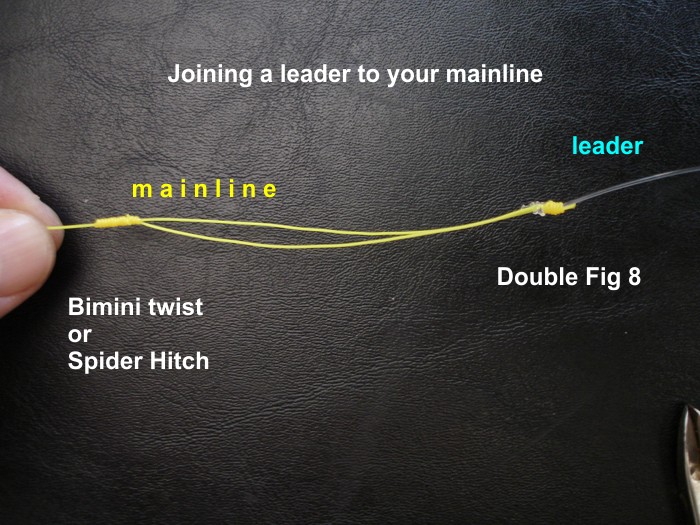
The leader should be double the length of your rod. What this does is it allows you to wind a few turns of the stronger leader onto the spool of your reel, allowing you to make the cast off your leader. The initial force on the line during a cast places huge strain on the mono, so having a thicker leader on your reel allows you to throw much harder, preventing snapoffs on the cast.
A leader also provides other benefits such as greater abrasion resistance and strength on the business end.
The ReelKnow the components and functions of your reel. Learning to cast with a multiplier is easier when you know how things work.
Centrifugal Brakes
Many reels are made with Centrifugal brakes as part of the reel.
These are designed scientifically to help brake the spool when it's needed. Most of the World's greatest distance casters use some sort of mechanical braking system in their reels - either centrifugal or magnetic. These brakes help to brake a reel spool when it is spinning fast.
They are there for a reason - use them!!
All Daiwa reels come standard with Centrifugal brakes.
Shimano Trinidad's and the Penn Fathom also do.
The Penn Torque, Shimano Torium
do not have centrifugal brakes.
A braking system is very helpful when fishing at night and for those that don't fish too often.
Make sure your first reel has Centrifugal brakes, they help enormously.

Recently, some clever blokes have started
Static Magging their reels.
Static Mags make a massive difference to controlling the revolution of a Multiplier, making it easier to cast harder, so more confidence and therefore more distance.
Check out this thread on Static Mags - it will change your fishing experience!
http://www.ultimateangling.co.za/index.php?topic=17652.0
Cast Control knobFound on the handle side of the reel - turned tight will physically tighten a spring up against the spool shaft, making it more difficult to turn the spool.
Less tight, and the spool will turn faster and more freely.
When starting, tighten up the Cast control knob. As you become more confident, you can loosen the knob a quarter turn at a time, until you find a setting that is easiest for your style and expertise.
Clutch LeverAlso on the Handle side of the reel, is a lever called the Clutch lever. This disengages the gears of the reel from the spool gear, allowing it to free spool.
Just before you cast, you disengage this lever and hold the spool still with your left thumb.
As you cast, you release the spool by lifting your thumb.
 The Spool shoulder
Many reels are designed overseas for Offshore/boat fishing. South Africans have turned things completely upside down and made some boat reels the best casting reels under the sun! Proper casting reels, like the Daiwa Grandwave series, have a shoulder on the spool. This is where you place your thumb when you're ready to cast and when you're 'feathering' the reel during the sinker flight. Most of the reels don't have this shoulder, however, so one needs to find a spot on the lip of the spool to brake it.
Different reels have varying degrees of metal lips or shoulders on the spool...


When a reel is spinning at high revolutions, there will come a time where you will need to apply emergency brakes to the spool, often resulting in thumb burn - a nice big blister on your thumb!
This is caused by the line burning your skin when spinning out of control. This is why we try brake the reel on the metal lip. If you don't, you risk burning the line as well. If your thumb is being burnt, you can be sure that the line has been burnt too!
How to CastSee this post -
http://www.ultimateangling.co.za/index.php?topic=9711.0 and study the
Low Compression Off the Ground cast. Teach yourself how to do the basics right, then you can progress.
Procedure:
Inspect the line on the Reel. Make sure your leader knots are on the RHS of the spool, away from your casting thumb. This is important! A wildly spinning Double Fig 8 will gash your thumb open in an instant if you forget!
Tighten up the Cast control knob at first. This will help you in preventing an overwind, making the reel more controllable. With the Cast control tight, you won't get much distance, but distance is not the object here - learning how to control your equipment properly is the primary objective. With experience, you can loosen a quarter turn at a time. As the Cast control knob gets loosened, the reel will spin faster and the further you will cast.
The ideal setting for the Cast control knob - this is what you should aim at achieving - is when the knob is loose enough so that there is a tiny amount of lateral play in the spool. Too much lateral play will cause the spool to vibrate and brake itself against the reel frame.
Place your left thumb on the lip of the reel spool.

Disengage the Clutch lever.
Get your setup and stance right.
Swing the cast firmly and smoothly. NEVER jerk the rod - this WILL overwind the reel.
At the point of release (45deg in the sky), let go with your thumb.
The reel will now start spinning fast. Keep your thumb positioned above the spool so that you can just feel the line coming off the reel.
With experience, you will learn when the line coming off is too quick and a bunch is developing. At this point you lightly 'feather' the reel with your thumb to slow it down to a controllable speed.
Watch your sinker - as it slows down as it nears the water, begin braking the spool with your thumb. When it hits the water, brake the spool abruptly. If you don't, the sinker stops, but the reel doesn't stop spinning and you get the famous overwind! Don't worry about overwinds - everyone gets them - it's part of the game!
Bring the Scissors!!

Because of the absolute inevitablility of Overwinds in learning how to cast, one should shop carefully for mainline. Buy the cheaper brands of line to practice your casting with, and keep the more quality lines for your proper fishing.
The mechanics of an OverwindThe principles behind building a major overwind are relatively simple, and once understood, the means of stopping them becomes a lot clearer.
When a sinker is cast, the rod stops in the direction you want the sinker to go, and the acceleration provided by the rod straightening out, sends
the sinker away on its journey. At the same time, the line behind the sinker starts to pull line off the reel spool. Initially, the spool’s inertia resists the pull
of the line, but quickly the force exerted by the sinker on the line overcomes the spool’s inertia and it starts to spin, allowing line to follow the path of the
sinker.
But the reel spool extracts a price for allowing itself to be spun. It stores the energy it gained from its original inertia, and adds some extra centrifugal force
to its storehouse as well. There, this force waits for the best time to do the most harm. As soon as the sinker starts to slow down as it heads toward the
water, the force on the line being pulled off the reel lessens. Now is the first opportunity for the line on the spool to wreak its havoc. If the spool is not
slowed at this point it will carry on spinning faster than the line coming off it - spewing out loose loops of line that wrap around, under and over each other,
forming the dreaded… Overwind!
If the angler manages to get over this hurdle, the next chance for the spool to do some damage is when the sinker hits the water, and while no line is being pulled from the reel, the spool continues to spin. As above, unless the reel spool is stopped as the sinker hits the water it will go on spinning a wonderful web of loops and iliciting some of the most colourful language imagineable!

That's fishing!


