 Short line Nymphing
This post is a guideline to flyfishing for Yellowfish and Mudfish on the Vaal river. The techniques outlined here are by no means the only way to successfully flyfish the Vaal but will hopefully help out the novice getting started - this post is by no means the definitive guide! We will be looking at the technique known as "short line nymphing" to target fish on or near the bottom of the river.
Where do fish hold:One of the major factors that needs to be taken into account is where the fish are holding in the river, which is usually determined by the flow of the water. For the majority of the time most fish will be holding on or near the bottom of the river. The main reason for this is the flow of the water is much faster and stronger near the surface of the river, which means the fish will be expending unnecessary energy trying to hold here. On the bottom of the river the flow of the water is far slower due to friction and obstacles suach as rocks and stumps. Therefore the fish prefer to hold on or near the bottom as they expend less energy against the slower flow.
More specific lies, surface feeding etc. and where to look for fish, will be covered in a later post.
Strong currents and small flies:Theres an old saying when fishing the vaal which holds true here: "If you're not hooking up on the bottom, you're not fishing in the right place!"
So the main objective is to try and fish with the flies as close to the bottom of the river as possible. 2 things to consider here: Weighting the flies and leader diameter. The most effective way to get flies down to the required depth is to weight them. Most specialist flyshops will sell flies that have been tied using either lead underbodies or tungsten beads, or both. These flies are extremely effective in getting to the river bottom quickly and effectively.
If you battle to find Heavily weighted flies, then something to definately consider in your arsenal is splithot, its quick and easy to add, and you can control the weight needed or weight to be removed.
The thickness or diameter of your leader can also drastically affect the sinking rate of the flies. Ideally you need to balance a small diameter to a high breaking strain mono. The thicker the leader the slower the sink rate of your flies. Be careful of going too light on the breaking strain, not only is it easy to lose fish, but you can snap off the flies when you hook up on the bottom. Due to the fact that you don't need to cast more than 5 or so metres, its not necessary to used a shop bought tapered leader, a straight section of mono is more than adequate. Leader setups are covered next.
Typical leader setup:A general rule of thumb is to use a section of mono about as long as you flyrod. This length will allow you to adjust the position of the strike indicator to cover most differing depths of water you will encounter. Its important to use a strike indicator that is bouyant enough not to be dragged underwater by the flies. The most popular method of attaching flies to the leader, is to use what is known as the "new zealand' method. Two flies are attached, one heavy fly to control the depth (this is called the control fly) and a second unweighted fly hitching a ride down. (this second fly is called the point fly)
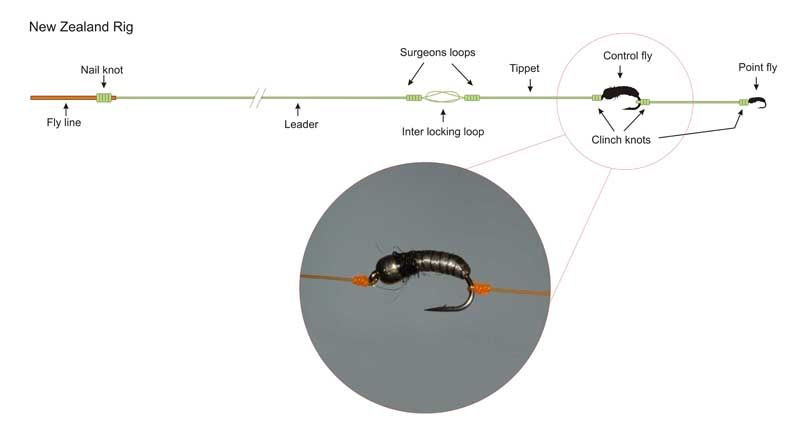
Placement of the strike indicator will help you to control the depth at which the control fly will drift. As a general rule its best to have one and a half times the depth of the water distance between the strike indicator and the control fly.

Two factors to take into account when adjusting the position of the strike indicator: Speed of the water flow and depth. Faster and deeper water, you will need to move the indicator further away from the control fly. Slower and shallower water move the strike indicator closer to the control fly. Very often you will feel the control fly "tap" the rocks on the bottom.
Too short a distance between the strike indicator and control fly:

Too big a distance between the strike indicator and control fly:

Perfect distance between the strike indicator and control fly:

A very good point to remember when trying to determine if your flies are in the "zone" is to watch the speed of the strike indicator while it is drifting. The strike indicator will always drift at the speed of the flies under the water, so ideally your strike indicator must be drifting slower than all the bubbles and debris on the surface. If you keep on hooking the bottom reduce the distance between the strike indicator and the control fly, a few centimetres at a time. Cast a metre or two above the section of water that you want to drift your flies through. This will allow the flies time to sink, so they will be drifting through the required zone at the correct depth.
When you are happy that your flies are in the correct zone, keep your eyes peeled and watch the strike indicator like a hawk. Any unnatural movement of the strike indicator can indicate a take: a brief slowing down or acceleration, dipping under the surface, movement to the sides, or if you really lucky sometimes the fish will hammer the fly and the indicator will race off!
Happy Nymphing!


