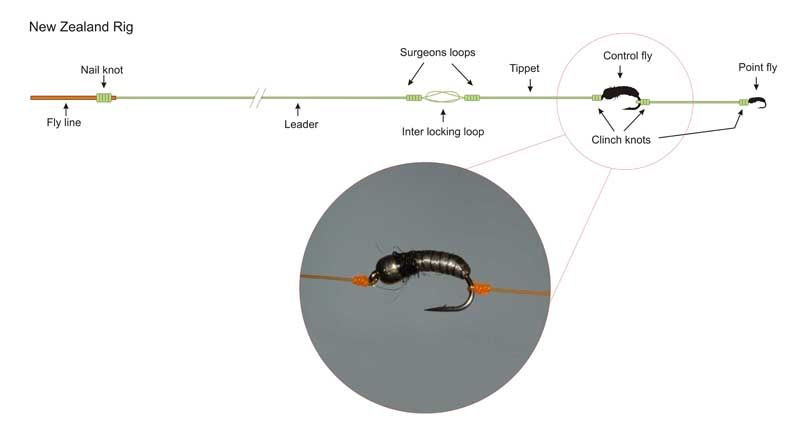
This rig is simple and quick to setup. The knots I've chosen in the diagram are not the
only knots to use, they can be changed as per personal preference. In rivers the primary
purpose of fishing two flies is to be able to control the depth at which the flies are
drifting. The Point fly is connected to the Control fly via a piece of mono, with a
simple clinch knot tied on the bend of the hook. The Control fly is generally the heavy
fly, which will pull the lighter, or unweighted, point fly down to the required depth.
Again this is not a hard and fast rule, eg: both flies can be lightly weighted, the
combined weight then being heavy enough to pull both flies down. Or both flies can be
unweighted - if tied slim and dense enough, the flies will still sink to the correct
drifting depth. The length of the tippet section will depend on the depth of the water
to be fished. The section of line between the Control fly and Point fly is usually about
30cm long. Again this is a guideline and can be changed. The strike indicator is placed
on the leader section, between the fly line and the loop to loop connection.
A two fly rig is extremely effective when fishing in stillwaters as well. In fact
personally I never fish a single fly setup at all anymore. The most popular technique is
to tie on an attractor pattern as a "control" fly and then a smaller more realistic
pattern on the point. The point fly can be as small as a size 18! Patterns such as
Woolly Buggers and Dragonfly Nymphs make good attractors, and small Flashback nymphs or
Atomic worms can be deadly on the point.


